If you have ever flipped breaker after breaker, yelling down the hall “is it off yet?”, you are not alone. Most panels are labeled with faded pencil, or not at all. And nobody ever taught most of us how our home's electrical system actually works.
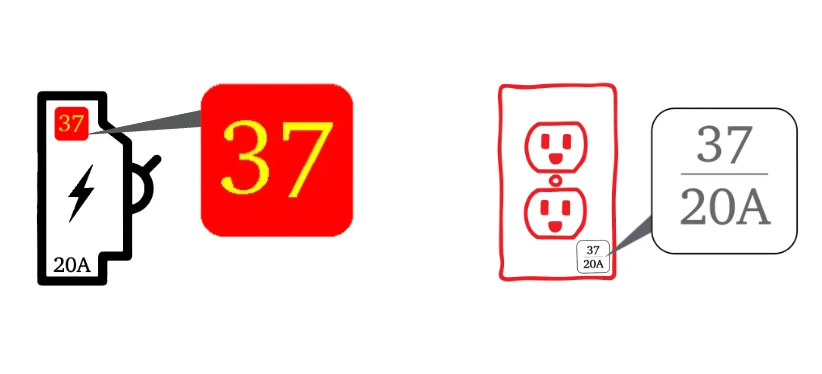
OUTLET IDs fixes that with a simple idea: give every receptacle and switch a number that matches its breaker, so you always know what is connected, where it is, and how much it can safely handle.
Breaker 37 in the panel. Every 37 label on the faceplate. No guessing.
It's not just smart. It's code.
NEC 408.4(A)
The National Electrical Code (NEC 408.4(A)) requires every circuit in your panel to be legibly identified by its clear, evident, and specific purpose, with enough detail to tell it apart from every other circuit. Vague or missing labels like "lights" or "misc" don't meet that standard, and they can get flagged at an electrical inspection or a home inspection when you sell.
The NEC requires every circuit to be labeled at the panel. OUTLET IDs™ goes a step further, labeling every receptacle and switch with its breaker number and amp rating, so you know exactly what each breaker controls.
“Every circuit and circuit modification shall be legibly identified as to its clear, evident, and specific purpose or use. The identification shall include an approved degree of detail that allows each circuit to be distinguished from all others. Spare positions that contain unused overcurrent devices or switches shall be described accordingly. The identification shall be included in a circuit directory that is located on the face, inside of, or in an approved location adjacent to the panel door in the case of a panelboard and at each switch or circuit breaker in a switchboard or switchgear. No circuit shall be described in a manner that depends on transient conditions of occupancy.”
NEC 2023, 408.4(A) Circuit Directory or Circuit Identification
The Panel Directory sheet folds and attaches inside your panel door, giving every circuit its own clear, specific description, the way 408.4(A) asks.
Three simple steps
How it works
1
Identify circuits
Label your breakers with the Breaker Labels so every circuit has a number.
2
Label receptacles & switches
Apply OUTLET IDs labels to your receptacle covers and switch plates, so each one shows its circuit number and amp rating.
3
Monitor loads
Use the Limit The Load magnet to help prevent overloads, right where you need the reminder.
What's included
Everything you need in one kit
Educational InformationPlain-language pages on receptacles, switches, breakers, GFCI and AFCI protection, avoiding overloads, and everyday electrical safety.
Fillable SheetsReceptacle directory, panel directory, tally sheet, circuit diagram and notes pages to document your whole home.
OUTLET IDs Labeling SystemNumbered labels for receptacles and switches, 1 through 42 over 15A and 20A, like “37 / 20A”.
Breaker LabelsRed and yellow numbered labels for every breaker in your panel.
Limit The Load MagnetA quick reference to help you keep circuits from being overloaded.
It starts with plain language pages on how your system works, so you can recognize issues while you label.
Electricity ExplainedHow power actually reaches your home and what trips a breaker.
Preventing OverloadAmps, watts, and how to add up what runs on one circuit.
Common Receptacles15A and 20A, 120V and 240V, and what each can handle.
AFCI/GFCI ProtectionWhat each one guards against and how to test them.
Receptacle DangersHow to spot a loose or overheating connection using your senses.
Common Plugs and Faulty PlugsWhy you never modify a plug, and when to stop using one.
LightingMatching bulbs to fixtures and never exceeding a fixture's wattage rating.
Common Breakers and Faulty BreakersBreaker types, warning signs, and how to reset a tripped breaker.
Extension Cord DangersPicking the right cord for the job and using it safely.
Surge ProtectionThe types of surge protection and when a surge protector needs replacing.
Fire ControlFire safety items the book recommends keeping in every home.
Conversion ChartTypical amp use for common items, to help you estimate the load on a circuit.
Plus the labeling system itself: installation guide, tally sheets, circuit diagram sheets, panel directory, and notes pages.
Why it matters
Improve safety
Quickly identify circuits and reduce risks
Save time
Easier troubleshooting and renovations
Add value
A well labeled panel helps future homeowners
Front and back cover. Learn, Label, Monitor, Maintain.
Your home gives you clues
Know the warning signs
A breaker that hasn't tripped doesn't prove the wiring is safe. A loose or worn connection can overheat even on a normal load. The book teaches you to notice the signs:
See
Burnt, melted, or scorched receptacles and plugs. Scorch marks around a breaker. Plugs that fit loosely.
Hear
Popping or buzzing at a receptacle. Humming, buzzing, or popping from a breaker.
Smell
A burning smell, or a fishy one.
Feel
A receptacle, breaker, panel, or extension cord that is warm or hot.
Plus what to watch for around the house
Breakers that keep trippingOr won't turn on or off.
Overloaded circuitsLike a space heater and a hair dryer running on the same circuit.
Extension cord misuseCords under rugs, power strips plugged into cords, or cords running space heaters.
Adapters and power stripsThey add connection points, not capacity.
Voltage dropsLights that dim when something big turns on. A plug-in power meter that reads volts shows the drop while a heavy-use item runs. Over 5%, call a qualified electrician.
The book walks you through what each sign means, what to do, and when to call a qualified electrician.
Quick guide inside the covers
The basics, right where you need them
The educational text contains a quick reference so the answers are in your hand when you are standing at the panel.
AFCI vs GFCITwo kinds of protection: AFCI guards against arc faults, GFCI guards people against shock from ground faults.
15A vs 20AWhat the amp rating on a circuit means and how to tell them apart.
Common circuit loadsWhat typical appliances draw, so you can plan what shares a circuit.
Warning signsWhat to watch for so small problems get attention early.
Homeowner tipsSimple habits for keeping your system labeled and safe.
Made with love, and a little history
Roma J. Richard Jr., 1937 to 2020
OUTLET IDs is dedicated to our father and grandfather, Roma J. Richard Jr. He was born in 1937 and passed in 2020, and those years live on our label as 37 over 20A. He is woven into every part of this product.
OUTLET IDs was invented by Jenn Rich, a certified home inspector with decades of hands-on experience in roofing and remodeling. Hailey Scott brought it to life with the artwork and design. Together they bring 55 years of combined electrical experience to every page. It is the guide the trades never handed homeowners, written for people who have never touched a breaker panel in their life.
Our $37.20 launch price is in his honor.
For everyone who lives with an electrical system
Who it's for
If your home has receptacles and a breaker panel, this is for you. Especially:
New homeowners getting to know their house
Anyone buying or selling a home
Renters who want answers
Rental owners and landlords
Property managers
New builds and recent renovations
A gift for the person who handles everything around the house
Questions
Who is OUTLET IDs for?
Any homeowner who wants to understand their electrical system. Whether you just bought your first home, have lived in yours for twenty years without opening the panel, or are tired of playing the breaker flipping game, it meets you where you are.
What's in the kit?
Educational information, fillable sheets (receptacle directory, panel directory, tally sheet, circuit diagram and notes pages), the OUTLET IDs labeling system for receptacles and switches, Breaker Labels, and the Limit The Load magnet.
Do I need to be an electrician?
No. It is written in plain language for everyday homeowners. OUTLET IDs is about identifying, labeling and understanding your circuits. For any repair or wiring work, call a qualified electrician.
Where should the Limit The Load magnet go?
Somewhere you will see it: on the outside of your breaker panel door, inside the door right next to your breakers, or on your fridge if it is magnetic.
Does it follow the NEC?
Yes. OUTLET IDs is built for NEC panel labeling.
Does it work outside the U.S.?
OUTLET IDs™ was designed for U.S. residential electrical systems (120/240 volt, 60 Hz). The educational information was developed for the National Electrical Code (NEC) as used in the United States. The use outside of these systems is at your own risk.
Where is it made?
OUTLET IDs is made in Greenville, SC, USA by Proactive Homeowners LLC.
What is your return policy?
You can return an unused kit within 30 days for a full refund. Return shipping is on you. If your kit arrives damaged or missing something, send us a photo and we will replace it free. Once labels have been applied, the kit is final sale since the labels can't be reused. Questions? Email: hello@proactivehomeowners.com
Take control of your home's electrical system.
OUTLET IDs gives you the tools and knowledge to confidently understand and manage your home's electrical system. One label at a time.